Data and AI Discovery  

    Skip to page content

    A business-driven approach to designing implementation-ready data and AI solutions.

    Data and AI initiatives rarely succeed by starting with technology. First, it is necessary to understand the work, decisions or processes that need support. Data & AI Design / Discovery starts with a concrete business use case. Using product-oriented thinking, we shape it into an implementation-ready solution: what value it creates, for whom, with which data, in what context, with what quality commitments, and with what responsibilities.

    The outcome of the engagement is an engineering-ready specification and a prototype that enable the solution to be evaluated quickly and moved towards implementation.


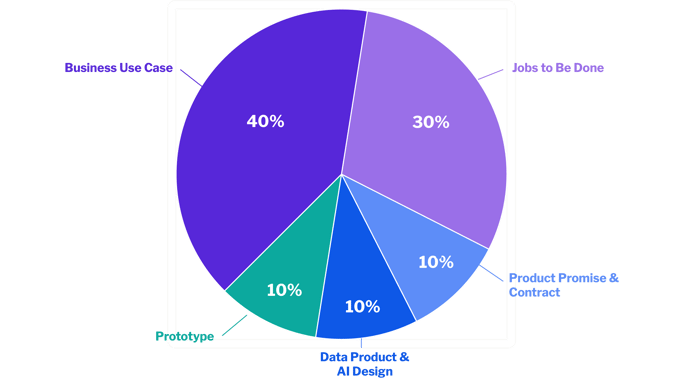
    How the work progresses:

    Business Use Case

    Jobs to Be Done

    Product Promise & Contract

    Data Product & AI Design

    Prototype

    We identify the most significant business use case and define the targeted business value.

    We determine what users need to accomplish, what decisions they need to make, and what information they require.

    We define the solution promise, data requirements, quality requirements, metrics and responsibilities.

    We shape the use case into a feasible data and AI solution using data product thinking.

    We build a prototype that allows the solution to be evaluated in practice and helps plan the next development steps.

    pie-chart-of-different-phases-on-data-and-ai-product-design

    An AI tool alone does not create scalable value. Value is created when business expertise, algorithmic literacy, workflows, decisions and data requirements are connected.

    Reskilling the Workforce for AI: Domain Expertise and Algorithmic Literacy
    Tambe B.
    Management Science, 2026

    Business first 

    Successful data and AI solutions begin with a business need, not with technology. The most effective starting point is always a concrete use case: a task, decision or process that needs to be improved.

    The goal is not to remain at a general conceptual level or to examine technological possibilities separately from the business context. The objective is to identify what should be built next, under what conditions the solution can be implemented, and how it will generate business value.

    This perspective helps direct development efforts to where they will have the greatest impact. At the same time, it ensures that data, AI, automation and AI agents support business objectives rather than becoming isolated technology projects.

    Typical starting points include:

    • improving maintenance and service efficiency
    • increasing the effectiveness of customer support operations
    • accelerating access to information for field personnel
    • anticipating spare parts requirements
    • improving reporting and decision-making
    • creating situational awareness
    • leveraging dispersed information through AI solutions

    People at the centre of the solution

    A good data or AI solution starts with people. What do users need to accomplish, and what kinds of decisions do they make in their work?

    Technology helps people succeed in their work. For this reason, use case definition focuses on understanding real work-related needs before solutions are designed.

    Users may include maintenance specialists, field personnel, customer service teams, sales teams, production staff, designers or management. Once their goals, information needs and workflow challenges are understood sufficiently well, the role of data, automation and AI can also be defined realistically.

    This helps build solutions that do not remain experiments but become solutions that people use.

    When people are involved in designing the solution from the beginning, they also develop a better understanding of how data, automation and AI can support their own work. This supports the implementation of change and helps build new capabilities within the organization.

    Read an example of how AI can be used to identify emotional and disruption-related situations.

    Contract-first development: creating a shared understanding first

    One of the most common reasons for delays in data and AI initiatives is that different parties have different views of what is being built. Contract-first development provides a shared machine-readable language for business and data professionals.

    The objective is to establish a common understanding before implementation begins. In practice, this means making the key assumptions, objectives and responsibilities of the solution visible in a structured format as early as possible.

    During the engagement, we define for example:

    • what data the solution requires
    • what the information means in the specific use case
    • what level of data quality is sufficient
    • how current the information must be
    • how success will be measured
    • who is responsible for the information, its quality and its business significance

    For example, a Data Contract acts as a bridge between business requirements and the technical implementation of a data product. A machine-readable document serves two purposes: 1) a shared commitment regarding what the solution must deliver and 2) the conditions under which it operates.

    When expectations are clear, implementation can proceed faster and with lower risk.

    Read how data contracts support trustworthy AI.

    AI and data through product thinking

    Data & AI Discovery applies product-oriented thinking, where a data-driven solution is viewed as a business-critical product rather than a standalone project.

    A product has users, a purpose, an owner, quality requirements, metrics and a lifecycle. Governance is addressed at the same time as the product takes shape. The purpose of the product is to create value for a defined user group, not merely to provide technical access to data.

    A good data product does not begin with a dataset. It begins with a use case.

    In product-oriented thinking, the use case is described as a whole that considers:

    • users and their needs
    • business value
    • required data and context
    • quality requirements
    • metrics and success monitoring
    • ownership and responsibilities
    • implementation constraints

    The work is facilitated and uses proven standardised templates that enable the solution to be described clearly from the perspectives of the business, users and implementation.

    At Ambientia, you are guided by an experienced team that combines expertise in data engineering and business design.


    ambientia-leaf-musta-30vuotta

    Designed for rapid implementation

    In the past, design work often took several weeks or months. Today, the situation is different, as the best processes use AI to support modelling and design activities. 

    The goal of Data & AI Discovery is to create a sufficiently clear view of the solution so that its feasibility can be evaluated quickly and its development can be initiated in a controlled manner.

    The outcome is not an idea paper or a generic development recommendation. The goal is an engineering-ready specification that can be used as the foundation for building the next phase of a new data or AI product. At the same time, costs, priorities and timelines become more tangible.

    Rapid implementation is not achieved by cutting corners in the design phase. It is achieved by making the right things sufficiently clear from the start and by using AI in a controlled manner. At the same time, the organisation learns to identify which data and AI solutions should be built next and under what conditions they can be successfully brought into production.

    When value, users, data, context, quality requirements and responsibilities have been defined with sufficient precision, implementation can begin with significantly lower risk. This also helps avoid situations where a technical project is forced to resolve business ambiguities during implementation.

    Typical use cases

    Data & AI Discovery is suitable for situations where the business challenge is known, but the optimal solution or implementation approach is not yet clear.

    Typical use cases include:

    • Field operations support
      How can field personnel find the right information, historical data, instructions or recommended next actions the moment they need them?
    • Maintenance optimisation
      How can the resourcing, execution and documentation of maintenance activities be guided through data, automation and AI? 
    • Predictive failure and spare parts management
      How can data help anticipate failures, spare parts requirements and inventory optimisation before the issue becomes visible to the customer?
    • Customer support and order processes
      How can customer support, sales and order fulfilment processes gain access to the right information faster and with less manual effort?
    • Reporting and analytics
      How can dispersed data be transformed into reliable, understandable information that supports decision-making?


    What are the outcomes of the engagement?

    Data & AI Discovery provides a concrete foundation for future development.

    The end results may include:

    • we always ensure that your team's AI capabilities and algorithmic literacy continue to grow
    • a prioritised use case and business value description
    • a data or AI solution concept
    • a data product specification
    • a data contract description
    • key architecture and integration principles as well as a governance perspective (AI/Data Governance)
    • a prototype or proof of concept
    • an engineering-ready specification
    • the foundation materials required for implementation planning
    • a shared view of the business objectives and success metrics of the solution

    The goal is to move the discussion from ideas to implementation. When business objectives, users, data, responsibilities and the solution approach have been defined with sufficient clarity, implementation can begin significantly faster and with greater predictability.

    Take the first step towards leveraging AI

    Data & AI Discovery is a step towards the systematic use of AI.

    The future of work depends on the choices made today. By investing in people and capability development, we ensure that the benefits of AI are distributed widely. Ambientia always ensures that your team's expertise continues to grow.

    Contact us! Let's discuss how your organisation can move from ideas to practical implementation in a controlled way.